
MCA Revises DIR-3 KYC Norms: Key Changes Effective from 31 March 2026
Introduction
The Ministry of Corporate Affairs (MCA) has amended the DIR-3 KYC guidelines, resulting a shift in how directors maintain KYC compliance. This change will take effect from March 31, 2026, and is expected to decrease repetitive filings while maintaining the accuracy and transparency of director information.
For directors and businesses, this is more than just a procedural shift. It has a direct impact on compliance deadlines, penalties, and how DIN (Director Identification Number) records are handled.
In this blog, we will discuss what has changed, why the amendment was introduced, and what directors must do to be compliant.
What is DIR-3 KYC?
DIR-3 KYC is a mandated compliance requirement for all individuals with a Director Identification Number. It guarantees that the MCA database contains current and accurate information regarding directors.
Directors are required to submit details such as:
- Personal information
- PAN and Aadhaar
- Email ID and mobile number
- Residential address
The purpose is to prevent misuse of DINs and maintain transparency in corporate governance.
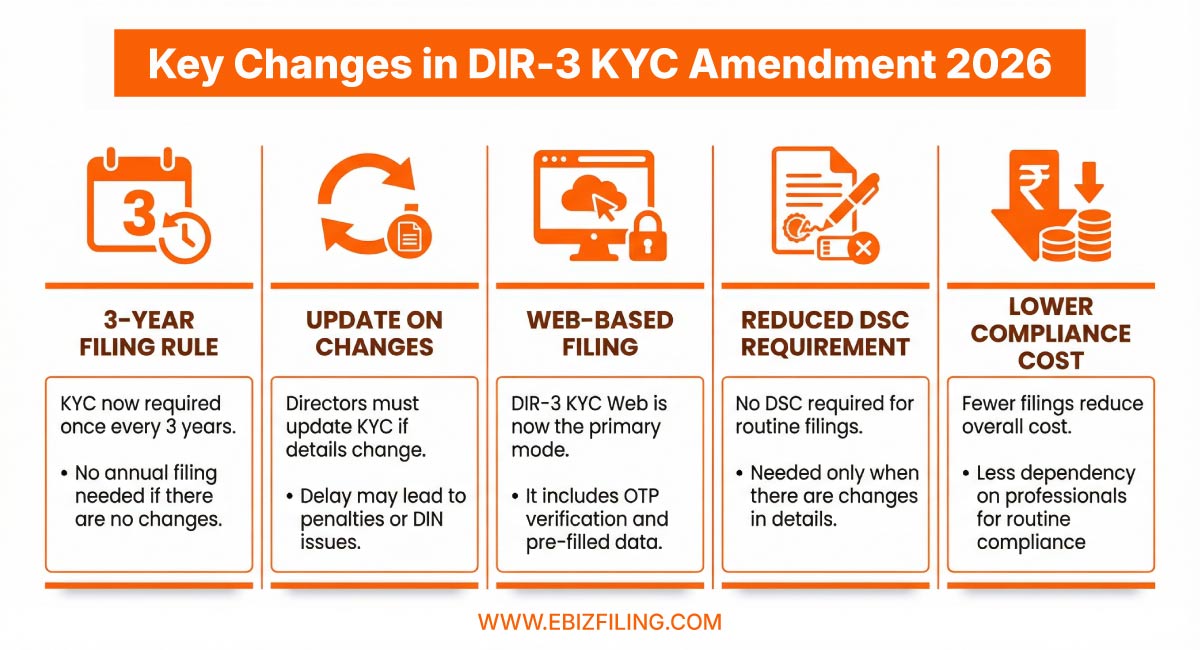
Key Changes in DIR-3 KYC Amendment
The new MCA amendment significantly changes the frequency with which directors must file DIR-3 KYC.
1. 3-Year Filing Requirement Introduced
Previously, directors were obliged to submit DIR-3 KYC every year. MCA is taking steps toward a lower frequency system with this change. Unless something changes, the filing obligation will be once every three years.
This lowers the need for directors to comply repeatedly when their information does not change.
2. Mandatory Update for Changes in Details
Even though the frequency has been lowered, directors must still update their KYC information anytime there is a change in:
- Mobile number
- Email Address
- Residential address
- Identification documents
Failure to update changes on time can still result in penalties.
3. DIR-3-KYC-Web becomes the primary filing mode.
MCA modified the procedure using a web-based interface.
Features:
- OTP verification.
- Pre-filled data
- Minimal documentation.
- Faster approval.
This supports MCA’s digital compliance transformation effort.
4. Reduced DSC and professional certification requirements.
One of the most practical changes to the updated DIR-3 KYC requirements is the reduction in reliance on Digital Signature Certificates (DSC) and professional certification.
Under the new framework:
- Routine KYC filings every three years may not require DSC or professional certification.
- KYC filings generated by changes in details will still need valid certification.
This improvement is expected to decrease compliance expenses for directors significantly. It also reduces the need to hire professionals for routine filings, making the process easier and more accessible.
However, for any additions or revisions to director details, certification procedures will remain in place to assure the accuracy and legitimacy of the information given.
5. Lower Compliance Cost
One of the key benefits of the DIR-3 KYC amendment is the reduction in overall compliance costs. Since directors are no longer required to file KYC every year, the frequency of filings has decreased significantly.
This also reduces dependency on professionals for routine filings, as certification may not be required in standard cases. As a result, directors can save on professional fees while managing compliance more efficiently.
Due Dates Under New DIR-3 KYC Framework
While MCA will communicate specific timelines, the overall framework is as follows:
- Filing once every three years.
- Event updated within 30 days.
- Non-compliance leads to DIN deactivation risk.
Directors should keep an internal compliance tracker.
Penalty for not filing Director KYC
Even if the filing frequency has been lowered, compliance remains necessary. If the Director KYC is not filed before the deadline, various repercussions may apply.
Director KYC is one of numerous regulatory forms that directors are required to submit as part of the ROC filing checklist for private enterprises.
Possible results include:
- The DIN may be listed as inactive due to non-filing.
- The director cannot sign company documents.
- The DIN can only be restored if KYC has been submitted.
- A late fee of approximately ₹5,000 may be needed.
What Is the Difference Between the Old Director KYC Rule and the New Rule 2026?
|
Feature |
Old Director KYC Rule (Before 2026) |
MCA Director KYC New Rule in 2026 |
|
KYC Filing Frequency |
Directors had to file KYC every year |
Directors must file KYC once every 3 years |
|
KYC Filing Method |
DIR-3 KYC e-Form or DIR-3 KYC Web |
DIR-3 KYC Web through the MCA portal |
|
Filing Deadline |
30 September |
30 June (in the due year) |
|
Penalty for Late Filing |
₹5,000 late fee and DIN marked inactive |
₹5,000 late fee and DIN may be deactivated |
|
Professional Certification |
Required annually often |
Required only if the director’s details change |
Benefits of the DIR-3 KYC Amendment
The recent amendment to DIR-3 KYC rules brings practical advantages for directors, companies, and professionals. It shifts the focus from repetitive filings to smarter compliance.
For Directors
Directors will experience a clear reduction in compliance burden. Since the filing frequency is lowered, they no longer need to complete KYC every year if there are no changes. This also leads to lower professional fees, as routine filings may not require certification. The overall process becomes simpler, more flexible, and easier to manage without constant follow-ups.
For Companies
Companies benefit from reduced administrative effort. Earlier, ensuring annual KYC compliance for all directors required continuous follow-ups. With the new system, compliance tracking becomes more streamlined. Companies can now focus on monitoring actual changes instead of managing repetitive yearly filings.
For Professionals
For professionals, this amendment shifts the nature of work. Instead of handling routine filings, the focus will move towards advisory services. This includes guiding clients on compliance timelines, handling change-based filings, and ensuring proper documentation. It creates an opportunity to provide more value-driven services rather than repetitive form submissions.
Tips for Directors
- Keep your KYC details updated at all times.
- Track your KYC due date carefully.
- Ensure your mobile and email are active.
- Keep documents ready for quick filing.
- Update immediately if any detail changes.
- Consult a professional for complex cases.
DIR-3 KYC Services by Ebizfiling
- We assist you with DIR-3 KYC filing as per the latest MCA rules.
- We help update your director details whenever changes occur.
- We support DIN reactivation in case of non-compliance.
- We guide you on new filing timelines and requirements.
- We handle document preparation and verification for accuracy.
- We provide end-to-end support to help you avoid penalties.
You can check official document of MCA for DIR 3 KYC Notice.
Conclusion
The DIR-3 KYC amendment effective from 31 March 2026 reflects MCA’s move towards smarter compliance. By reducing filing frequency and focusing on accurate data, the new system simplifies processes without compromising transparency.
Directors must still remain proactive as timely updates and proper tracking are essential to avoid penalties and ensure smooth compliance.